
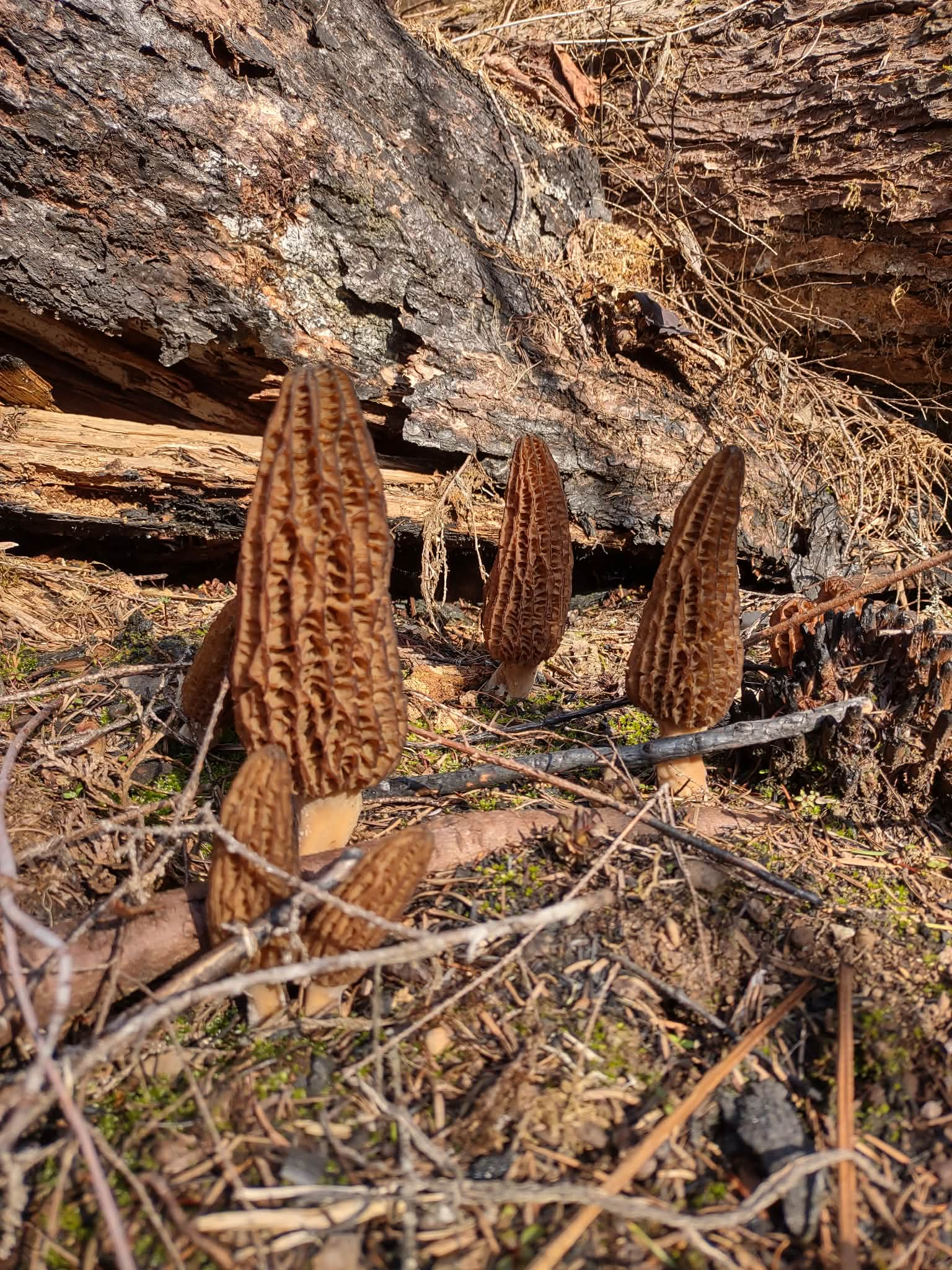
By the time May rolls in with her warm sunshine, the soil temperatures start to rise, and morels are on my mind. These delectable, meaty mushrooms can be rather elusive, but well worth the time spent finding them.
There are numerous species of morels that grow in the Pacific Northwest. One of the more commonly spotted species is the landscape morel, Morchella importuna. This morel favors wood chips in heavily disturbed, landscaped areas.

If you are wandering backwater areas, along the floodplains of rivers and creeks, where the dominant trees are hardwoods, especially cottonwood, you may encounter several different species in the morel family. You may find the early morels, Verpa bohemica and Verpa conica, or the half-free morel, Morchella populiphila, as well as the riparian morel, Morchella americana.

Another eco-region where morels can be found is in the burn areas, after wildfires. They can fruit in copious quantities after a fire, and numerous morel species can be picked if you are lucky enough to know when and where to look.

It is important to note that members of the morel family are poisonous. ALL morels must be well-cooked before eating. Improper or incomplete cooking can lead to gastrointestinal distress or in some cases, where the mushrooms were consumed raw, death, so proper care and knowledge is required when preparing and eating these seasonal, tasty morsels. Even with proper cooking, some folk’s systems just don’t agree with certain mushrooms, so if you have never eaten morels before, it is best to try a small amount the first time, to see if you have any adverse reaction, before consuming a larger quantity.
All photos by Katie Neall