
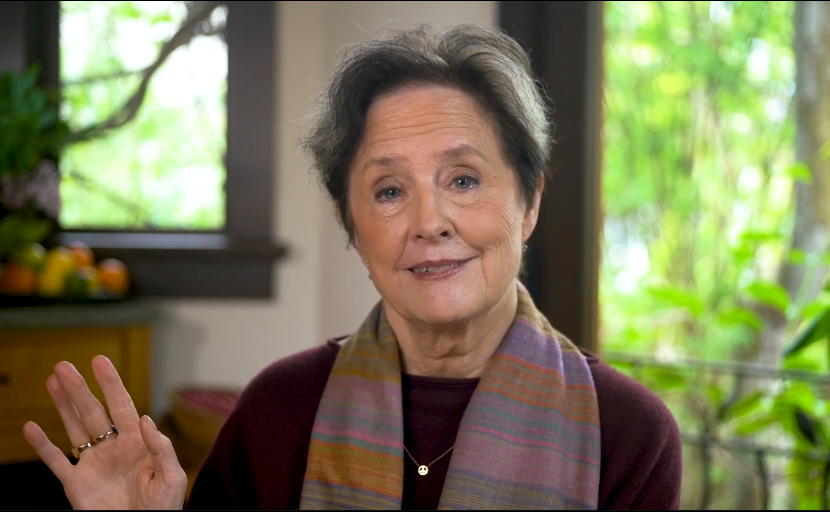
I hopped on a Slow Food USA webinar today hosted by executive director Kris Reid featuring a conversation with Alice Waters. As you may know, Alice has been a key figure in Slow Food since the beginning. She’s served as a vice president of Slow Food International for decades, alongside founder Carlo Petrini, and in this webinar she joked that she’s technically never stepped down from the role.
She and Petrini co-authored a book together back in 2004, and she said reading passages from it recently, she was struck by how little the movement’s core ideas have shifted since then. She’s authored forwards for several other Slow Food-related books. She’s also been showing up at Slow Food events around the country that she says most people don’t even know are happening such as a school garden visit in Miami and a tour of a regenerative farm an hour outside of Miami. A few months ago she attended a 500-person gathering of farmers in upstate New York, where she said the crowd gave her a standing ovation for talking about school-supported agriculture.
[Goals for our own chapter….the Hudson Valley Slow Food chapter Vice-Chair is Mona Talbott, who started her career working under Alice at Chez Panisse and was later chosen by Alice to launch the Rome Sustainable Food Project. That project produced a cookbook called Zuppa, which I’m happy to have on my bookshelf. I don’t have a connection to anyone that well-known in the food world, do you? If you do, let me know and we’ll plan an event! But I digress.]
Alice grew up in New Jersey right after World War II, and her parents kept a victory garden that turned into a whole neighborhood affair. Her family grew apples and strawberries, the neighbors across the street grew carrots and lettuce, and everyone shared. She talked about how a school field trip to a Wonder Bread factory left an impression on her (not a good one), even though her mother had her eating wheat germ and brown bread instead of the white bread and jam all her friends got. She traced her lifelong curiosity about whole foods back to those experiences.
The real turning point for her was a junior year abroad in France, where a meal at a small restaurant in Brittany changed everything for her. The trout came from the stream under the building, the raspberries came from the hillside outside. There was no menu of different choices, the meal was just what was actually available from right there. That experience became the blueprint for Chez Panisse.
The Montessori method
Alice trained in the Montessori method in London in 1968 (she joked she went partly for the Beatles), and she kept finding herself agreeing with one important Montessori idea which is that beauty is a language of care, and that we actually learn through our senses — smell, taste, touch. She talked about the Montessori idea of learning by doing so that your hands can feel whatever it is that you’re working on. She talked about burning rosemary and thyme outside Chez Panisse before opening so the smell would draw people in. She also recalled using calligraphy to create the menus herself in the early days, so it was obvious that things were made by hand.
Many people are probably aware that Alice for decades has championed the importance of school gardens. This grew out of a newspaper comment she made about how run-down Martin Luther King Middle School looked near her house. The principal called her up and asked if she wanted to help fix it. That conversation turned into a 10-acre garden and a full kitchen classroom, where academic subjects got taught through cooking and growing food. She said the program has since been used to train people at something like 5,000 schools around the world.
Her favorite detail is that she wants school lunchrooms to feel the way her old restaurant did, right down to placemats printed with lessons and even music playing while kids eat.
Alice is 82 years old now. Chez Panisse opened in 1971. She said she’s never once regretted going to work there, in all that 55 years. One thing she’s proud of: when she had a child and couldn’t work six days a week anymore, she and another chef split the job three days each, but they both got paid for six days. [That chef was Paul Bertolli, whose book Cooking By Hand is an inspiration.] She said that structure has kept the whole “family” of the restaurant together ever since, cooks included, and now she’s watching some of those cooks’ grandkids come work in the cafe.
Food, democracy, and politics
She connected communal eating directly to democracy — literally sitting at a table together, tasting something, and talking about whether it’s good enough or needs more salt. She’s been friends with California Governor Gavin Newsom since he let her put a garden in front of San Francisco’s Civic Center years ago, and she’s now working with Gov. Newsom’s wife, Jennifer Newsom, on getting organic, regenerative food sourced directly from farmers (no middleman) into more California schools, modeled on what Paris has done for its school system.
Climate change and trying to slow its impact came up a lot in her talk. She cited the United Nation’s 2030 deadline for sustainable development and said regenerative farming and purchasing food straight from the farmer is the best shot she sees at both feeding kids well and helping farmers survive climate disruption. She didn’t frame it as something we “should” do. She said it is “something “vital.” The food-purchasing power of schools is one of the few levers big enough to make it happen.
The School Lunch Revolution
“The School Lunch Revolution” is the title of her most recent book, which was published in October 2025 by Penguin Press. Her vision for a revolutionary school lunch is that children receive only what’s in season, bought directly from local farmers, served family-style at long tables so kids share food the way people always have. She told a story about a video of kids passing around a bowl of apples, each kid taking a bite and telling the next person to try it. She made her point that eating together is what actually gets kids to eat.
The audience got to ask some questions.
On farmed salmon: She’s now firmly against it, after tasting wild salmon from right outside the Golden Gate that she said moved her to tears. Chez Panisse has been serving wild salmon in every meal since.
On farm to school programs: She’s optimistic it can scale, and is making a documentary at UC Berkeley to show the whole chain from farm to kitchen to kids eating.
On childhood hunger in agricultural regions like the Central Valley: She circled back to regenerative farming and school support as the path forward, tied again to the 2030 climate window.
If you didn’t know about this event and want to make sure you don’t miss similar events in the future, visit the Slow Food USA website where events are listed.